
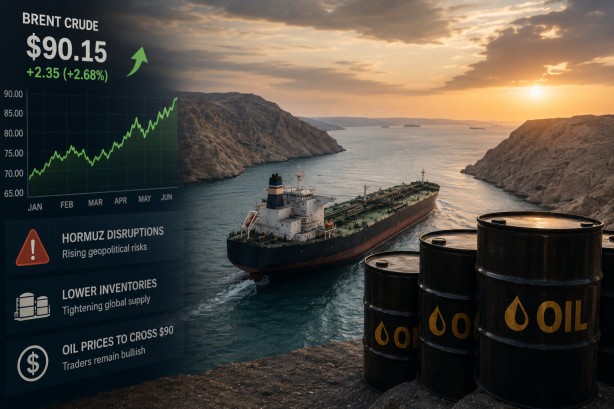
Oil prices have experienced their most significant weekly increase since April, although analysts suggest that Brent crude will require a sustained disturbance in the Strait of Hormuz or evident signs of global supply constraints to surpass the $90 per barrel mark.
This week, Brent crude was trading around $85 after an 11% increase, while the US benchmark, West Texas Intermediate, neared $80. The price surge comes amid renewed tensions between the United States and Iran, impacting supply routes in the Middle East and reducing tanker traffic through the critical Strait of Hormuz.
Despite the heightened regional tensions, Brent crude has struggled to exceed this week’s peak of $87.55 per barrel. Market analysts indicate that traders are still counting on diplomatic efforts to avert a long-term crisis. The Strait of Hormuz remains a focal point for energy markets, with approximately 20% of the world’s oil supply passing through this channel. The slowdown in tanker movements has companies closely watching the region’s security situation.
The effects of these developments are already visible in fuel markets. In the United States, refining margins have increased due to tightening diesel and gasoline supplies, while European fuel markets are also experiencing mounting pressure. Additionally, further disruptions in Russian exports have exacerbated concerns about global supply stability.
Analysts assert that oil prices are unlikely to decisively surpass $90 unless there is a significant decline in inventories or if tensions between Washington and Tehran escalate further, leading to a prolonged disruption of shipping through the Strait of Hormuz. For now, traders are concentrating on diplomatic progress and supply data to anticipate the next major movement in global oil markets.