
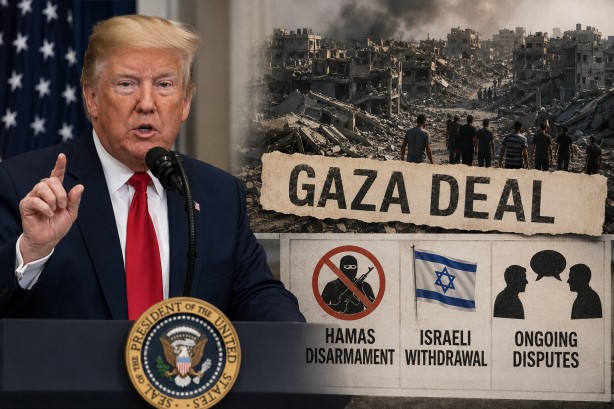
US President Donald Trump has announced a significant breakthrough in efforts to resolve the conflict between Israel and Hamas. A new agreement proposes the disarmament of Hamas and the withdrawal of Israeli forces from Gaza, aiming to pave the way for a stable Palestinian administration in the region while securing Israel’s future safety. This plan builds upon previous ceasefire initiatives, advocating for the surrender of Hamas’s weapons, dismantling of its tunnel network, withdrawal of Israeli troops, the establishment of a technocratic Palestinian government, the stationing of an international security force, and the reconstruction of Gaza.
Despite the ambitious framework, substantial disagreements persist regarding the plan’s execution. Hamas insists it will not begin disarmament until Israel has completely withdrawn from Gaza, demanding simultaneous action from both parties. On the other hand, Israeli officials maintain that complete disarmament and demilitarization of Gaza must occur before any Israeli troop withdrawal. US officials have recognized these significant differences and noted Israel’s apprehension about Hamas’s willingness to adhere to the disarmament clauses.
In a related development, Hamas has expressed its intention to dissolve its governing body in Gaza, transferring control to a UN-backed technical committee as part of the broader peace proposal. Ongoing discussions involving mediators from Egypt, Qatar, and Turkey aim to refine the implementation details to ensure all parties reach a consensus on the agreement’s terms.
While diplomatic channels continue to work towards a resolution, hostilities on the ground persist. Israeli military operations and airstrikes remain active in Gaza, and Israel has signaled plans to extend its military control over the territory, underscoring the formidable challenges to achieving a long-term ceasefire. The ongoing violence highlights the complexities and urgency in reaching a sustainable and effective peace agreement between the conflicting parties.